
The Australian construction industry is undergoing a critical cultural shift. Safe Work Australia has recently launched a comprehensive suite of resources specifically tailored to help employers identify, assess, and manage the risks of gender-based violence (GBV) on worksites. Developed in collaboration with industry stakeholders, these tools aim to address the unique Work Health and Safety (WHS) challenges faced by women and gender-diverse workers in a traditionally male-dominated sector.
Understanding Gender-Based Violence as a WHS Hazard
Gender-based violence is not just a “social issue” it is a psychosocial hazard. Under WHS laws, employers have a legal obligation to manage these risks just as they would manage the risk of a fall from heights or a faulty piece of machinery.
What constitutes Gender-Based Violence?
GBV is any behavior that humiliates, intimidates, or threatens a person based on their sex, gender, or sexual orientation. On a construction site, this can manifest as:
-
Physical violence or threats of harm.
-
Sexual harassment (unwelcome comments, touching, or requests).
-
Verbal abuse and bullying.
-
Offensive language and posters/materials that reinforce harmful stereotypes.
Why Construction is at Higher Risk
While GBV can happen in any workplace, the construction industry faces specific “risk multipliers.” Safe Work Australia identifies several factors that can increase the likelihood of harmful behaviors if not managed:
| Risk Category | Specific Factors in Construction |
| Workforce Characteristics | Male-dominated environments, high numbers of young workers, and a transient (sub-contractor) workforce. |
| Work Design | High job demands, tight deadlines, and pressure to “toughen up.” |
| Environmental Factors | Isolated work areas, remote sites, and low levels of supervisor support. |
Practical Tools for the Job Site
The new resources are designed for immediate, practical use. They move beyond theory and provide clear visual aids and real-world scenarios to spark conversation and change.
Infographics: Breaking the Cycle
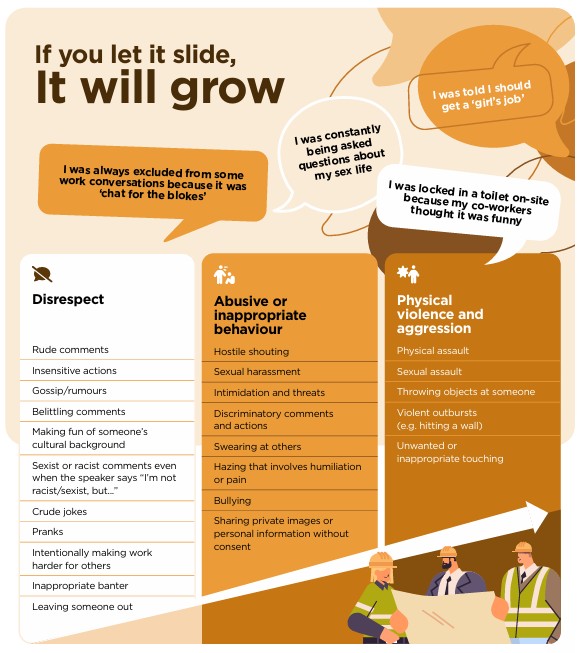
The infographics, such as “If you let it slide, it will grow,” highlight the “slippery slope” of workplace culture. They illustrate how ignoring small comments or “casual” sexism creates an environment where more serious violence can eventually occur.
Posters: High Visibility Awareness
Designed for site sheds and communal areas, these posters clarify roles and rights:
-
For Employers: Outlining legal responsibilities to provide a safe environment.
-
For Bystanders: Empowering workers to speak up when they witness inappropriate behavior.
-
For Victims: Clearly stating worker rights and how to seek support.
Case Studies: Managing Psychosocial Hazards
The release includes detailed case studies on managing workplace violence and psychosocial hazards. These provide a roadmap for PCBUs (Persons Conducting a Business or Undertaking) to conduct risk assessments and implement effective control measures.
Take Action: Resources for Your Site
Safe Work Australia encourages all construction leaders to download and implement these materials to foster a culture of respect.
Available Resources Include:
-
Guidance: Workplace violence in construction – Hazards and control measures.
-
Case Studies: Real-world applications of risk management.
-
Visual Aids: Infographics like “Why bad culture sticks around on site” and posters defining gender-based violence.
- For more information and to download the full toolkit, visit the official Safe Work Australia website.
Supporting information
- Case study: Managing the risk of gender-based violence in construction
- Case study: Managing the risk of psychosocial hazards in construction
- Guidance: Workplace violence in construction – Hazards and control measures
- Poster: What is gender-based violence?
- Poster: Your rights as a worker
- Poster: Employer responsibilities
- Poster: What to do as a bystander
- Poster: Keeping our worksite safe from gender-based violence
- Infographic: Why bad culture sticks around on site
- Infographic: Preventing gender-based violence starts with respect
- Psychosocial hazards
- Model Code of Practice: Managing psychosocial hazards at work
- Model Code of Practice: Sexual and gender-based harassment
The bottom line: Preventing gender-based violence starts with respect. By acknowledging these behaviors as safety hazards, the construction industry can build a more inclusive, productive, and secure future for all workers.